Fortune Business Insights: The global printed electronics market has reached $14.89 billion
In 2024, spending on the global printed electronics market amounted to $14.89 billion. For comparison, the industry was valued at $12.56 billion the year before. Thus, an increase of approximately 19% was recorded. These figures are reflected in a study by Fortune Business Insights, the results of which were published on April 8, 2025.
Printed electronics involves forming electronic circuits using specialized printing equipment. It enables the application of special inks—conductive, semiconductive, or resistive—onto a substrate surface. As a result, it is possible to create active and passive components, as well as interconnections, according to an electrical circuit. Various materials can be used as substrates, including paper, plastic, and even fabric. The technology allows for the production of flexible, lightweight, and low-cost electronic devices for a wide range of applications — from RFID tags and flexible displays to sensors and smart packaging.
Artificial intelligence technologies are named by analysts as one of the market drivers. AI algorithms simplify and accelerate product design. Such systems can automatically generate different design variants and optimize the layout of electronic circuits while ensuring the required efficiency and functionality. The expansion of the Internet of Things (IoT) infrastructure also contributes to the development of the printed electronics sector.
In addition, progress in the development of next-generation materials has a positive impact on the industry. It is the properties of the materials that largely define the differences between printed and conventional electronics. In particular, printed materials provide such advantages as mechanical flexibility and the possibility of functional customization through chemical modification.
However, there are also restraining factors. One of them is the high cost of research and development in the relevant field. Moreover, printed electronics often involve lengthy testing cycles before commercialization. Because of these uncertainties, investors may question the feasibility of funding such projects.
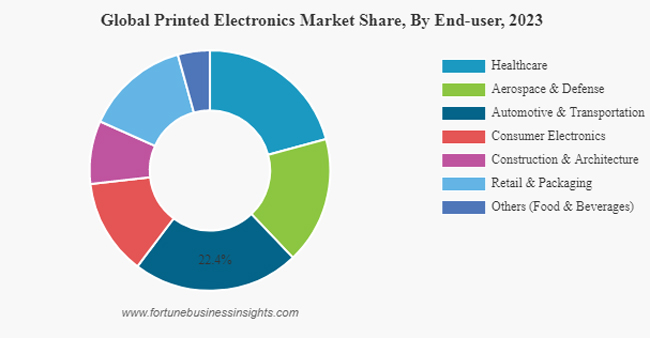
From a technological perspective, the market is segmented into screen printing, inkjet printing, and others. The first of these methods holds the largest share, as it is suitable for manufacturing electronics on an industrial scale. At the same time, inkjet printing shows the highest growth rates. Analysts highlight sectors such as healthcare, aerospace and defense industries, automotive and transportation, consumer electronics, construction and architecture, retail, packaging, and others in terms of application areas. The automotive and transportation segment held the largest share in 2023, approximately 22.4%. Geographically, the Asia-Pacific region leads, with spending reaching $4.24 billion in 2023. Globally, the list of major players includes:
- Molex;
- Agfa-Gevaert Group;
- Quad Industries;
- DuPont de Nemours;
- Nissha;
- Basf;
- NovaCentrix;
- E Ink Holdings;
- Panasonic;
- Enfucell Oy;
- SonoPlot;
- Linepro Controls;
- Almax;
- Caplinq Corporation;
- Merck KGaA;
- Mekoprint;
- Kuen Yuh Machinery Engineering Co.;
- Saralon;
- Cicor Group.
Analysts at Fortune Business Insights believe that, going forward, the compound annual growth rate (CAGR) in the printed electronics market will be around 22.4%. As a result, spending could increase to $75.05 billion by 2032.
Source: Printed Electronics Market Size, Share & Industry Analysis